Two Years

First – I apologize in advance, this post is an explosion of thoughts, and may not be very orderly...

March 12th, 2015...

As I was getting ready for work yesterday, I got a text from a friend back home saying “Thinking about you all today.”  I was most definitely confused… but also running late (as usual) so I temporarily dismissed it and continued to get ready. 

Fast forward 30 minutes, I’m pulling into the parking lot on base and I start racking my brain again…what did Jess mean by that text??

And it hits me.

I am instantly overwhelmed.  Tears threaten my eyes and the wind has been knocked out of me. 
Today is March 12th.  Mom would take her last breath tonight, about 1am, two years ago.

I forgot.

I forgot.

How could I forget???  What kind of person am I?

And now it’s all flooding back.  I’m not sure if it’s the guilt of forgetting or just the shear reality check (or both) but I suddenly am overwhelmed and wanting to hug my mom more than anything in the world…but I can’t.

To catch a few of you up, I relocated from Pittsburgh to southern California for a job on Marine Corps Base, Camp Pendleton in December.  The job opportunity was one I did not want to pass up, but I’d be lying if I didn’t admit I also saw California as a fresh start.  My family and I spent almost 6 years watching dementia take away my mother and grandmother.

And since March 12th, 2013 – we’ve had to bury my mom, followed by my grandmother 6 months later (who also had frontotemporal dementia (FTD), and then just this past October -- our grandpop—a man who loved his wife so much that he stayed by her side for 67 years—and until my grandmother took her last breath, slept on a chair next to her, refusing to leave her side (if that’s not love, I don’t know what is). 

Then to top it off, in early Nov, I had to put Woody down – Woody was my mom’s dog that eventually became mine.  He was in our family for 15 years.

So, needless to say, it’s been an emotionally exhausting few years.  And since I’ve been out here, I’ve selfishly taken a break from it all.  I haven’t finalized this year’s benefit yet (thinking pig roast, everyone???), I haven’t written on here in ages…

I’ve relocated the FTD bracelet from my wrist to my gear shift in the car….
Heck, most people out here know nothing about my past at all.   As Christina put it, “we are in the quiet after the storm.”

….

My friend’s text brought me back to reality.  And while it’s not an easy one to face – I spent most of yesterday with a very heavy heart and holding back tears—this is reality none the less.  

FTD is a part of my family's past, it will be part of our future, and while I may have forgotten, for a moment, yesterday morning, FTD is part of everyday life too, even in California.

Every time I mess up a word and say “drive” when I meant “fly” or “spoon” when I meant “knife” – my throat tightens and my inner voice screams “FTD! FTD! It’s coming!!” and I suppress my fear and externally laugh off the mistake to the surrounding audience.

Every time I see my nieces and nephews, I pray to God they are safe and ok. 

I have not forgotten.

And so, in tribute to my mom on her death anniversary, and to remind everyone out there whom also have loved ones with dementia, that as hard as it is to see them in their current state – that’s not them, that’s the disease; I want to close by sharing one of my favorite memories of my mom before she was sick.  A memory that demonstrates her true personality – one that always thought of others first.

/////

When I was 20, I studied abroad in England.  My 21st birthday was celebrated over there and I returned later on that summer.   On my return trip, I had a 7 hour layover in Chicago; which I was not looking forward to.  When I landed there, I turned on my phone for the first time in 8 months.  I quickly skip through all of the very outdated voicemails, but stop in my tracks when I get to the very last one.

It’s my mom’s voice.

“Hi Betsy!!  I wanted to surprise you in Chicago and take you around the city…but as usual, it’s raining in Pittsburgh and my flight is delayed. I’ll see you soon!  Love you!”
I couldn’t believe it.  My mom was flying to Chicago to spend a whopping 7 hours with me.  Of course, I’m crying with happiness and laughing at the ironic circumstances. 


My mind instantly gets to work.

Paper, I need paper.

I have none. 


I go straight to the bathroom – paper towels will do.  I find a table and lay out my paper towels and begin to write.

I hold up my masterpiece.  “MOM, Welcome to Chicago.”  Perfect!

I look up her gate number, and head there with my “sign” – ready for her arrival.

And I wait.
And I wait…

Nearly FIVE hours later, my mom arrives.  I give her the biggest hug.  She looks at me and says, “Well, I think we have just enough time to buy you your first legal beer in the US before we need to get on the plane back to Pittsburgh.”

And we do just that.  I did not see Chicago.  But I don’t care.  I had my first legal beer in Chicago O’Hare with my mom, who flew there only to give me a hug, tell me she loves me, and get right back on a plane.


~I love you, mom.  I miss you, mom.  And I wont forget.~


The Quiet After the Storm

~Written by Christina (Hall) Valencia

It has been almost 2 years since Mary (Mom) died, 18 months since Margaret (Nanny) has died and almost a year since our last post. Our family is experiencing what I referred to in previous posts as the quiet before the storm, except that it is now a quiet after the storm.  

While the quiet after the storm has allowed us to live a little without Frontotemporal Dementia (FTD) on our brain at every turn; it has not taken the want to make a phone call or share a story away. 

It is giving us time to prepare for the next wave of storms. But what does that mean?

To me it means, making hard decisions about what is best for my family and me. I have made a decision that at age 40, I will get tested for the gene. At 40, my girls (now 3 and 4) will be 11 and 12, old enough in my mind to understand and be able to formulate questions. 

I will have a plan for end of life decisions.

This quiet has also allowed me to enjoy my kids without the guilt that I felt initially for even possibly having the DNA that could negatively impact their futures. Although they cannot remember it, they re-share the stories that I have told them. Emma will remind me how Grandma Hall would try to catch her before she fell as Emma was learning how to walk, and Lil will tell me how Grandma Hall used to love to hold her. Both true stories created by the storm. These are good memories.

The quiet has brought Mary’s five children together, with their spouses, children, father and Mary’s father for a grand vacation this past August at one of Mary’s favorite places, the Jersey Shore (well not the Jersey Shore, but a place very close to it). At the shore we were able to have the kids who live states apart forge irreplaceable memories. My girls will never forget how cousin Henry (age 2) caught a fish with his bare hands, how he touched a dead puffer fish that had washed ashore. How Aunt Meggie, really had the baby that caused her to waddle the 1/3 of a mile to the beach, holding a row of hands, 8 in all, trying not to get caught on the street sign poles....How one day we watched as hundreds of dolphins migrated northward. 

Each of those memories and appreciation for what we have came to fruition because of our storm of dementia and the quiet that followed.

The challenge of the quiet, is the unknown longevity of it.  Hopefully it will last, but as it does, it is our responsibility to keep the energy of our initial drive to help raise money to cure FTD and raise FTD awareness alive.

This blog is meant to inspire and remember, and I challenge those who read it or have read it to share a short, long or short, about themselves or loved ones, either before, during or after their own experiences with dementia. Our family will be hosting the second annual Mary Hall Benefit for Dementia Research this summer. 

Please stay tuned for more information.


~In Memory of Jack Flanagan, Father, Grandfather and friend to everyone he ever encountered.  A man whose love kept him by his wife's side for 67 years, even as dementia took her away~

March 13th, 2014 -- It’s already been a year. FTD/PPA explained.

March 13, 2013 about 3am – Mom had finally had enough of FTD/PPA and let go.  Today is March 13th, 2014.  I can’t believe it’s been a year.  On November 3rd, our grandmother “Nanny” also had had enough of FTD and took her place with Mom. 

While I think my entire family is thankful 2013 is over; we are thankful Mom and Nanny are finally “whole” again and at peace and “we are thankful for everyday we've had with them and every day wont – bc that is one less day they are suffering.” 

While this is all true, it is independent of how much we miss them both.  Too often, I find that I have forgotten, and I pick up the phone to call my mom and tell her news, and then reality hits.

Breath gone, stabbing pain in the chest, stinging in the eyes.

Tomorrow – March 14th, I will turn 30, and Mom won’t be there.  One day I hope to get married and I’ll have to go wedding dress shopping without her.  My kids will never meet her.  

It’s not fair.  

But no one ever promised life would be.

I smile at this because I can hear my mom’s voice.  So many times growing up, I would want something and she would say no, and I would say it’s not fair and her response would be, “Tough.  Life isn’t fair.”
So yes, today is one year from when Mom let go.  It feels like yesterday and it hurts just as much today as it has for the last 6 years.  But, I have two choices.  I can cry about it (which, trust me, I have and will some more) or I can do something about it.

Our family chose the latter. 

As you all likely know by now, our family is hosting a Memorial Benefit on April 26th, 2014 (See EVENTS tab above for details).  Last year, with your help, we raised over $5,000 for The Bluefield Project to cure dementia.  Our goal this year is to exceed that.   We’re off to a good start—check out the donation tracker to the right!

If you have been following this blog, you know it was FTD that my mom and nanny had.  And you also know that it is genetic. 

However, if we are going to ask you to support/attend a Benefit (which will be lots of fun so you should definitely come!), I think it is fair I take a pause and explain some science behind FTD and more importantly – why do funds go to the Bluefield Project.

Bottom line:  Bluefield Project and the CFR= hope.  They focus on the genetic FTD our family is inflicted with—with they believe will that the findings will have parallel benefits to other neurodegenerative diseases, including Alzheimer’s, ALS, and cerebral traumatic encephalopathy – which is only now receiving attention in the area of contact sports.

Keep reading for a little genetic FTD 101 lesson. In advance, thanks for listening J (Sources for the below: a mix of U of Penn, Bluefield Project, Alzheimer’s Association and The AFTD)

What is FTD?
FTD used to be referred to as “Pick’s Disease.”  Today, Frontotemporal degeneration (FTD) refers to a family of disorders characterized by the progressive loss of neurons (brain cells) in the frontal and temporal regions of the brain.  Although the precise cause is unknown, FTD is thought to result from abnormal accumulation of misfolded proteins, which disrupt, and eventually kill, brain cells. 

What are early signs/symptoms?
Patients with Frontotemporal degeneration can present with different clinical symptoms, ranging from behavioral impairments to language or motor dysfunction.  Mom and Nanny were first language impairment and eventually motor dysfunction as well.


If you had to describe FTD in one sentence, what would it be?
FTD strips you, in your prime (40-60yrs, typically) of everything that makes us human -- insight, empathy, communication (ability read, write, understand), and sometimes personality.  

Is it treatable?
No, as of now, FTD is fatal upon diagnosis.  There is no treatment or cure.  There are some drugs that help ease symptoms, but nothing to actually treat the FTD.

But I've never heard of FTD - it must be rare.
Actually, it's not. It's the second most common form of dementia for younger generation-- even more common than Alzheimer's -- it's just often mis-diagnosed as depression/anxiety/Alzheimer's or not diagnosed at all.  With awareness and education, more and more cases are being discovered.

What are the different subtypes of FTD?  
Type of FTD
Clinical Description
Description of Possible Symptoms
Type of Pathology seen in Brain
behavioral variant FTD (bvFTD)
Changes in Personality, emotions and/or behaviors
- Hyperal (ex: eating only sweets or a certain type of food)
- Disinhibited actions (ex: making inappropriate comments)
-Apathy, lack of motivation to do things
-Lack of Insight (unaware of the impact of symptoms on others)
-Impaired decision makings
- Associated with the Tau or AD pathology
primary progressive aphasia (PPA) (nonfluent varient, semantic variant, and logopenic variant with subtle differences)
Deterioration in the ability to produce speech, understand words and recognize objects, ability to retrieve words in speech
- Hesitant, effortful speech
- Difficulty naming objects or recognizing the meaning of words
-Difficulty recognizing familiar objects or faces

- Nonfluent - most often linked to the tau protein; 
- Semantic - most often linked to the TDP-43 protein
-Logopenic - Most often associated with Alzheimer's (AD).
Corticobasal Syndrome (CBS)
Involuntary movements and/or cognitive dysfunction
-Apraxia ro difficulty w/ use of tools
-Executive or social deficits
- Cognitive problems such as simple math and difficulty with spacial orientation.
Tau or AD associated
Progressive Supranuclear Palsy (PSP)
Deterioration of gait and balance
-Hallmark feature is inability to move eyes up and down.  
- May also have other FTD subtype symptoms
Tau Protein
FTD with Amyotrophic Lateral Sclerosis (ALS)
Same changes seen in other subtypes of FTD accompanied by deterioration of the motor neurons
-Any symptoms associated with bvFTD or PPA
-muscle weakness and atrophy
-muscle cramps
-difficulty swallowing
-slurred/muted speech
TDP-43 Protein


What did Mary have? 
Both Mary and her mother (as well as our Uncle Steve, great grandmother and great great grandmother), have the FTD linked to the TDP-43 Protein.  Mom and Nanny both showed symptoms of the PPA subtype and FTD with ALS (commonly known as Lou Gehrig’s disease) subtype.

If it’s genetic, what are the odds of passing it on?
It's 50% (but I think "100% or 0% is more accurate).  For the subtype our family has and the subtype Bluefield Project has started clinical drug trials -- it's like brown eyes - it's a dominant gene that we were either born with or do not have at all.  

Let’s have a short science lesson, shall we??

Genetics 101:  Our genetic material, DNA, is stored in every cell of our body.  DNA chains are then packaged into larger units call chromosomes.  We have 46 chromosomes.  They come in pairs and in each pair – one is from our mother and one is from our father (22 pairs are “autosomal” and the 23rd pair determines our sex).

Genes are specific segments of DNA that carry the instructions for making proteins.
Proteins are molecules made up of a chain of amino acid building blocks.

Proteins are used by the body for maintain its structure and function.  Because our cells have two copies of every autosomal chromosome, this means we have two copies of each gene.

Remember this for later:
A mutation is a change in the DNA sequence; in other words there is a “spelling mistake” or typo in the instructions to make a protein.  So when there is mutation, that copy of a gene has the wrong instructions and so it makes a protein that does not function correctly in the body or is not produced in sufficient quantity.

(It is important to note – not every change identified in the DNA is automatically considered to be a disease-causing mutation.  Some are not harmful at all, but instead normal variations in the genetic code.)

So, what does that have to do with FTD?
Most cases of FTD are sporadic—no known family history.  But in some cases it is not.  See the below chart – our family is in the yellow.

A few terms: 

“Hereditary” indicates that a trait or disease can be directly transmitted between parent and offspring.
“Familial” is a very broad term used to indicate that more than one person in the family has a train or disease.  Familial denotes that there is a possibility of a genetic cause.
Now, remember “big R” and “little r”” from school? 

R = autosomal dominant.  “Autosomal” as noted above, means it’s from the 22 pairs of chromosomes that are identical in both males and females.  So both genders have an equal chance of being affected if a mutation is present on a gene in an autosomal chromosome.  “Dominant” inheritance means that only one copy of the gene has to have a mutation to cause the disease.
That’s where the 50% comes into play.  Dad has two “good” genes.  Mom has one mutated and one good one (remember, they come in pairs).  The mutated gene is big R in the box. 
Mom:
R
r
Dad:
r
r
We (the offspring) got a little r from our father since he has two little r’s.  There was a 50/50 shot that we got the little r from our mother.  If we got the little r, the mutated gene does not exist in us, we cannot pass it on.  “Skipping generations” is a myth.  Two little “r’s” = no mutation.
But If we have inherited the big R, we will eventually be diagnosed and now also have a 50/50 shot of passing it on. 

What is the mutated FTD gene called?
  • There have been a few mutated genes discovered, but to keep the conversation specific to our family, it is GRN.
  • GRN was only discovered in 2006 (mom was diagnosed in 2008). GRN codes for the protein “progranulin.”  Individuals with GRN mutations have abnormal accumulations of the TDP-43 protein in affected neurons.
  •  Average age of onset is 59 years—Range is 35 years old to 87 years old (Mom was 56, Nanny was 80).   
  • Why the age difference, you ask?  This will be discussed in a future post—this is a mystery that is still unraveling!

What does not having enough progranulin protein have to do with FTD?
Why not having enough progranulin causes frontotemporal dementia is unknown, but it’s the question driving research in frontotemporal dementia labs around the world. Progranulin is involved in a diverse range of biological processes including inflammation, tumorigenesis, development and wound repair. It is widely expressed in most tissues in the body, but it’s not necessary for life. Model animals, like mice and worms, can live and reproduce even without progranulin. Why loss of progranulin seems to preferentially impact the brain even though it’s involved in a host of processes is unknown.

What does loss of Progranulin do to brain cells?
The end result is that loss of progranulin causes brain cells to die. (And then literally, the brain shrinks). We don’t understand how this happens, but this is one of the major research focuses within Bluefield and the CFR. Recent data suggest that loss of progranulin results in an abnormal immune response in the brain – researchers are working to understand how this might cause neuron death.

You mentioned ALS?
Yes, ALS is also a form of dementia.  While ALS can exist on its own as well, research has confirmed links to certain FTD subtypes and ALS.  And the TDP-43 is one of the links.  (I will discuss this more in a later post as well).


AND FINALLY, who is the Bluefield Project/CFR and why should I donate anything toward them?
  • As noted above, the Bluefield Project = Hope.  REAL HOPE.    If there is any silver lining to having hereditary genetic disease, it’s the Bluefield Project.
  •  It’s tough to find a treatment or cure when you don’t even know the cause.   But the cause –  TDP-43- is known in my family’s case.
  • The Consortium for Frontotemporal Dementia Research (CFR) was established in 2008 by the founders of The Bluefield Project. Its mission is to find a treatment or cure for frontotemporal dementia though systematic collaboration of best-in-class scientific investigators.
  • Bluefield Project is based out of UCSF and manages a consortium of 16 principal investigators at nine Universities, who are funded to pursue research into the genetics, biology and translational research of the disease.  This includes international institutes as well.  In other words—they are SHARING information and COLLABORATING instead of keeping their research a secret and competing, which is so often the case in research. 
  • They are 5 years into a 10 year mandate to find a treatment or cure for FTD.
  • HOPE:  Led by a team composed of the highest caliber basic scientists and renowned clinical neurologists, with an aggressively funded research agenda and a unique research model, the CFR firmly believes that a cure for frontotemporal dementia is possible. 
  • Based upon the research they have supported, the first clinical trial with a drug to treat FTD was initiated in 2013. Recognizing that they do not have the funds to take a drug through registration trials, they have focused on using their research and translational science to identify a handful of potential targets in FTD, along with a number of drugs that engage these targets.
  • Bluefield Project was founded by a family (from Bluefield, Virginia) with the same genetic FTD who decided to do something about it.
  • Bluefield believes that the findings they have made in FTD will have parallel benefits to other neurodegenerative diseases, including Alzheimer’s and ALS and cerebral traumatic encephalopathy - which is only now receiving attention in the areas of contact sports.


In Conclusion,
There is hope and our family will do everything we can to help.   I'd like to share what my brother, Adam wrote today:

"PPA is cruel, there is no treatment, no preparing, no numbness, and the progression is just slow enough it challenges every bit of faith in a god you have. 

Not only did she have to watch herself die, but watch herself lose herself. We couldn’t say goodbye because it was too early, she couldn’t say goodbye because it was too late.

When I put my children to bed and the room is quiet, I think to myself I am grateful they are too young to remember the suffering, but it breaks my heart they will never feel the comfort of her presence and the reassurance of her voice. I know I will never be the parent or person that she was, nobody will. We can only keep her memory alive and strive to live up to her example. 

Maybe with enough awareness, the next grandmother will be able to tuck her grandchildren to bed.

I love you mom."

Mom’s mantra was “Deeds not words shall speak me.”  Mom always put herself second and family, friends and the community first.  It’s time for us to carry on her mantra. We are so quick to share funny pictures and stories on facebook/twitter etc.  Please consider sharing this post and supporting the fight against dementia by supporting Bluefield research by clicking here.  

Each and every one of us can tell a story about someone with dementia.  They never gave up on us, let’s not give up on them.

Thank you for listening.

Mom, Nanny – we love and miss you both.


~The Halls~

(if you would like to read more or have a concern about a loved one: UCSF has great information at http://memory.ucsf.edu/ftd/overview/ftd )

2014 Mary Hall Memorial Benefit is on!!!

Spring 2013, in memory of Mary Hall, Heidi and Betsy ran the Pittsburgh Marathon, and with your help, we were able to reach our goal of $5000.

This year, we wanted to do a fundraiser that gave back to the contributors.  To this end, we bring you the 
Mary Hall Memorial Benefit Bash!  

And....

You're Invited!  Click on the EVENTS page above for more details and to PURCHASE tickets!
Hope to see you there!! 

Battle Lost. War--Undecided

3 November 2013
Written by Christina 

~I initially wrote this after speaking with my grandfather and uncle, and they informed me that Nanny was not doing well that day. Later that evening we lost her. She left peacefully and with her passing comes the peace of knowing she is whole again.
This blog post is dedicated to our grandmother whose unparalleled patience, unending kindness and limitless love has shaped and guided us throughout the years. ~

Margaret Mary Flanagan (Marge/Nanny)
June 13th, 1928  - November 3rd, 2013 
Survived by her husband, sister, brother, son, daughter in law, son in law, 7 grandchildren and 5 great grandchildren. 


~~~~~~~~~~~~~~~~~~~~~~~~~~~~~~~~~~~~~~~~~~~~~~~~~~~~~~~~~


Battle Lost. War--Undecided

There is no fighting dementia, you can accept it, deny it, ignore it but once you get it. You lose. We just heard from our uncle and grandfather that our Nanny's health is failing. There is only so much that a person can take.

The challenge in this FTD (frontotemporal dementia) is that you just don't have to take it once. You have to take it over and over again.

Baba (Nanny’s grandmother)
Nan Marcin (Nanny’s mother)
Uncle Steve (Nanny’s younger brother)
Mom
Now, Nanny

Nanny and Grandpop were there for Nan Marcin and then again for Uncle Steve.

Grandpop, Uncle John, Aunt Debi, Dad and all of our generation has pulled together to support Nanny and Mom through their dementia.

My first memories of this ill-fated disease are with Mom's Uncle Steve. My last visit to Uncle Steve was etched in my ten year old mind. Dementia scared me then. I couldn't understand how someone could go from a person in pictures to what seemed like a living skeleton. Mom told us he could hear us but couldn't talk. He was so important to her. She used to tell us stories. After Uncle Steve passed I can remember thinking about how dementia ran in family and that I might get it.

As we grew up the dementia demon quieted down.

We lived a normal life full of soccer games, vacations and school. Dementia struck again as my father's mom Nana Hall aged. It seemed like normal aging. We lost her to a stroke in 2004 before the real signs of dementia set in.  I honestly thought we were in the clear for a while, losing people tears me apart and naive me thought I was safe.

2008 came with double diagnoses for Mom and Nanny.

2013 dementia took mom and she is whole again.

As the year comes to an end I don't know what to hope for. I understand that dementia will take Nanny's last breath; I also know that last breath will give her new life.

Dementia steals so much from each person it touches. It takes your imagined future and warps it. People you expected to stand next to you watch from across the room. Dementia takes what only death can give back. Each time that death gives life back to an affected person it stirs the reality that with our hereditary autosomal dominant gene that it will strike another that I love (Please see the first post for more details here).

This road that my brother, sisters and I walk is a sea of unknowns. Three of us have at least one child. Dementia is not stopping any of us from living our lives. It just pokes at us and reminds us that it may subside but unless the odds are in our favour we will, like Nanny and Grandpop, watch dementia steal more loved ones right before our eyes.


I do not know what my future holds. I do know that dementia will not take the memories of my grandmother's constant smile, cool, comforting hands (literally they were always cold but or unrelenting love for her family and faith. Nanny you will always be remembered in this way. 


If there is a silver lining to having a dominant, genetic form of this dementia, it is the Bluefield Project. 
They are a dedicated research team based out of UCSF, and their ability to support and educate about FTD is hope.  Their commitment is beginning to pay off, and clinical trials are on the horizon.  Please consider a donation and fight for a prevention of dementia.  Your donations go directly to research. 


FLASHBACK POST – Halloween, the early years.

(written through Betsy’s POV)

Tough guy, Henry

How my mom took five children trick or treating and kept track of us all – in the dark, running from house to house, high on sugar and adrenaline- amazes me to this day.

My mom would usually stay on the street and let us go up to the houses on our own.  I can still hear her voice, orchestrating our every move.  “Three houses.  After you get to the house with the red door, you come straight back and check in…”  We all take off…

“Adam! WALK, Do. Not. Run.”  Her command conjures imaginary strings that pull at the 10 year old boy and he comes to a fast halt followed by a slow, struggled walk – similar to a dog on leash that is desperate to take off again.   

“.... And say thank you!”

The streets, crowded with kids and adults, but it was always easy to find mom – She was infamous for adorning tacky Halloween attire.  Her trademark was the flashing pumpkins head band.  The small bright orange pumpkins, blinking in turn, contrasting with the blackness of the sky, and affixed to the headband by 4 inch antennas – giving the illusion that they were “floating” above her head was always easy to spot. 

One particular Halloween –  we were all toddlers to elementary school- it was exceptionally cold and snowy. 

My parents were considering not letting us trick or treat at all that year.  I cant even begin to imagine dealing with 5 small children after telling them they cant go trick or treating. 
Apparently, my mom could not either. 

So she ordered us all to go put on our snow suits, boots, gloves, hats, and scarves.  Meanwhile she went into the kitchen and met us back in the living room, holding 5 white garbage bags.  One for each child.  She painted 5 faces white and out the door we went (Dad stayed behind and gave out candy).   

A family of ghosts was born!
Mary Margaret saves the day again!

That was circa 1990...ish.

Twenty three years later, we are all grown up now.  Megan, Adam and Christina all took their 2 and 3 year olds out trick or treating this year.

I Facetimed with Tina right before she took Emma and Lily out. 

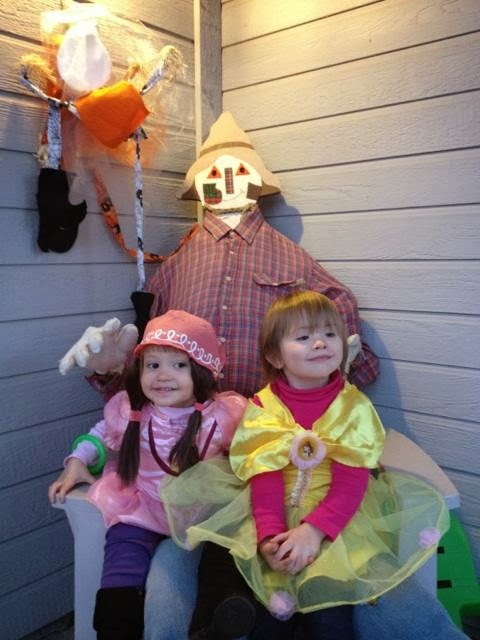
Emma (3 yrs old) was Bell from Beauty and the Beast and Lily (2 yrs old) was Izzy from Jack and the Pirates.

Even though they live in Arizona; Flagstaff, AZ is in the mountains and it’s already freezing there at night.  So both children were required to also wear turtle necks and long johns under their costume.  Tina was a bumble bee. She backs away from the camera so I can see her whole outfit.  She is wearing antennas with little yellow pom poms balls on the end.  My mind instantly flashes back to 20 years ago and her yellow pom poms are suddenly orange pumpkins.  

I smile to myself. Tina reminds me so much of Mom sometimes.  All of my siblings do.

“Ok, we gotta go.  Emmagene and Lily – say goodbye to Aunt Betsy.”

“Bye Aunt Betsy!!!”

Tina: “Say I love you”

“Love you!”  They squeak in their high pitched toddler voices as they rush to the door.   They are soooo excited, I can’t help but grin from ear to ear.  Christina ends the call and my screen goes blank.

It's the little things in life that make you laugh, smile and cry - sometimes all at once. 

Adam and Elly's son - Henry - 23 months - The Construction worker!


Cookie Monster is all smiles this year!  ...Megan and Chris's 2 yr old, Josh
Christina and Roth's girls - Lily and Emmagene (2 and 3) - aka "Izzy "and "Bell"

And finally.....our newest family member....

Margaret Flanagan Hall  ("Finn")- Born 10/22/2013 and named after my mom and Nanny:
(Mom- Mary Margaret Hall; Nanny: Margaret Mary Flanagan).  
Adam and Elly's little one slept through Halloween this year  :)


Too many of us can all share a story of a loved one inflicted with dementia. As noted in previous posts, this disease costs more than any other illness (including cancer) and impacts over 13 MILLION people (almost 4 million with dementia and over 9 million caregivers) .

A friend of the family - Lisa Wetzel - is one of the millions also affected and is trying also to raise awareness. To do so, she put together a team in memory of Grandmother and in honor of her other grandmother, aunt and step mom --- all whom have suffered or are suffering from Dementia -- to participate in the 2013 Walk to End Alzheimer's.

She has asked us to put up this post to bring awareness to about the Alzheimer's walk.

Please see the below link for more details.

2013 Walk to End Alzheimer's - Orlando, FL: Lisa and The Predheads - Alzheimer's Association act.alz.org
The Alzheimer's Association Walk to End Alzheimer's is the nation's largest event to fight Alzheimer's disease, with over 600 Walks nationwide. Join our Walk and help raise awareness and funds for vital Alzheimer's care, support and research.

Resources - online course for caregivers

Hi all,

I just wanted send out a  short post that may be helpful to those of you with a loved one with dementia of any kind -- Alzheimer's, Parkinsons, FTD, ..... etc.

The below was sent to me from an online support group member.  

Here is a link to an on-line course for caregivers of people with dementia:
 https://www.coursera.org/course/dementiacare (copy & paste)

It was recently mentioned in a blog post on the New York Times website: http://newoldage.blogs.nytimes.com/2013/09/05/online-lessons-in-dementia-management/?ref=health&_r=0 (copy & paste)

The course was developed by two renowned researchers in the field, Laura Gitlin, PhD and Nancy Hodgson, PhD, RN and is designed as a learning tool for a variety of caregivers, including professional and family caregivers. It is free and is a five week course, starting Oct 14, 2013.


Some highlights from the article:
"The point is to help people understand Alzheimer’s disease from a comprehensive perspective that encompasses not only its medical implications but social, psychological and environmental considerations,” Dr. Gitlin told me in an interview.

She’s especially focused on what she calls the “lived experience” of people with dementia. Caregivers and professionals “need to know about the different stages of this disease and how a person is functioning during these stages in their home, their family and their community,” she said. Only then does it become possible “to develop a supportive environment that allows the person to use the capabilities he or she still has.”

I've also put the above link under "Resources" so if you want to find it in the future or pass on to anyone - you dont have to dig up this post.

With over 15.4 million caregivers (a/o 2012) providing more than 17.5 billion hours of unpaid care valued at $216 billion.... thought this may be helpful to a few of you...

:)